Women’s Sports Lead NBC’s Primetime Milan Cortina Olympic Television Broadcast Coverage By Narrow Margin
(February 23, 2026) – Women’s sports received more coverage than men’s sports during NBC’s primetime television broadcast of the 2026 Milan Cortina Olympic Games, according to James R. Angelini (University of Delaware), and Paul J. MacArthur (Utica University), co-authors of the book Olympic Television: Broadcasting the Biggest Show on Earth.
Women’s sports received 42.43% of the coverage, while men’s sports received 41.33% of the coverage; the remainder featured mixed-sex events (16.24%).

When mixed sex events are excluded, women’s sports received 50.65% of the coverage compared to 49.35% for men’s sports.
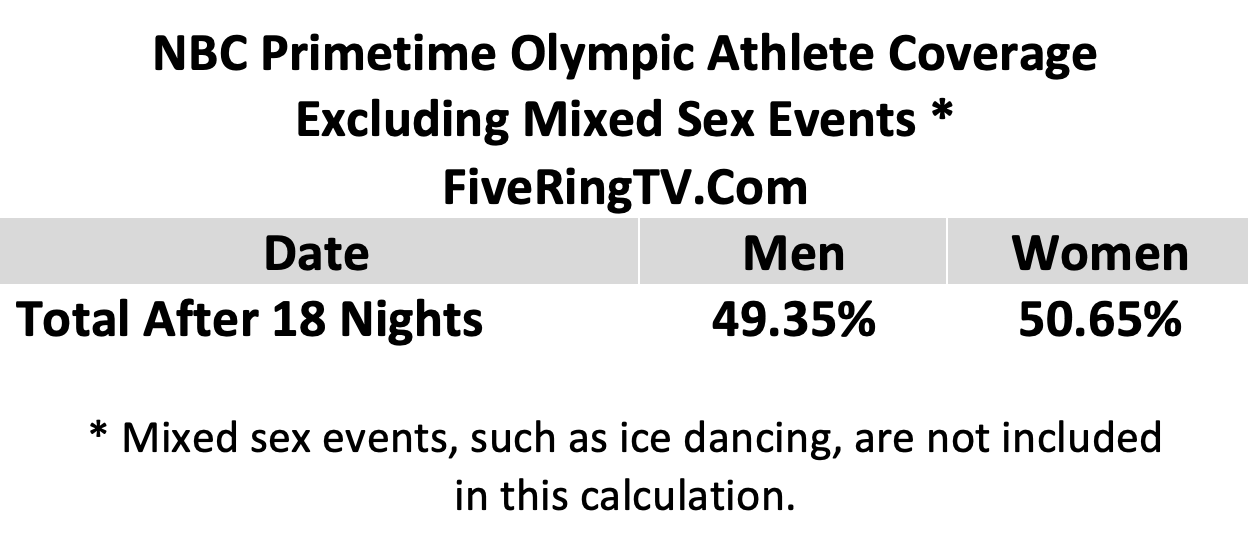
Over the course of 18 nights, women’s sports received 20 minutes and 28 seconds more coverage than men’s sports on NBC’s primetime Milan Cortina Games broadcast. Men’s sports led women’s sports coverage after 10 nights. This gap was erased by Night 15, when women’s sports took the lead and never relinquished it.
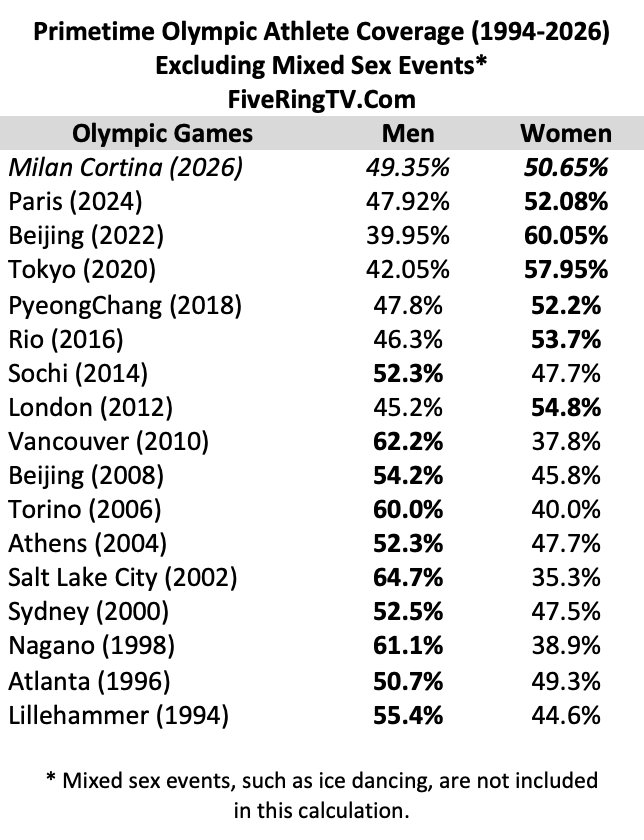
The 2026 Milan Cortina Games mark the sixth time in a row that women’s sports received more primetime Olympic broadcast coverage than men’s sports. Women’s sports have now received more coverage than men’s sports on NBC’s primetime broadcasts in seven of the past eight Olympic Games (London, Rio, PyeongChang, Tokyo, Beijing, Paris and Milan Cortina).
“NBC’s primetime Olympic broadcast remains an outlier,” says MacArthur. “It is the rare case where women’s sports are prioritized on one of a network’s most valuable primetime properties.”
NBC’s long-term trend of providing significant primetime coverage for women’s sport is likely influenced, in part, by the continued success of American women at the Olympic Games. Team USA women won 17 medals in 14 events, while Team USA men won 12 medals in 12 events. Four medals were won by Team USA in mixed sex events. In terms of gold medals, Team USA women won 6 compared to 4 for Team USA men, and 2 for Team USA in mixed sex sports.
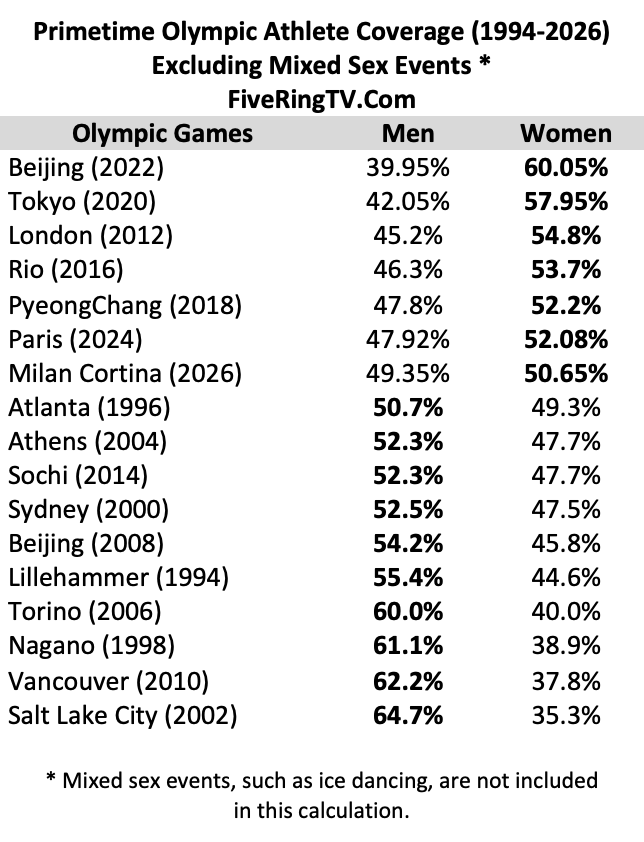
The margin of difference between men’s and women’s sports in NBC’s 2026 primetime Milan Cortina Olympic television broadcast is the smallest actual and percentage gap favoring men’s or women’s sports detected since studies began in 1994.
Three women’s sports received at least 30 minutes more coverage than their men’s sports counterparts: Bobsleigh, Alpine Skiing, and Figure Skating. Four men’s sports received at least 30 minutes more coverage than their women’s sports counterparts: Speed Skating, Freestyle Skiing, Cross Country Skiing, and Snowboarding.
“This is not surprising when you consider who NBC was promoting before the Winter Games even started,” says Angelini. “Mikaela Shiffrin, Lindsey Vonn, Elena Meyers Taylor, Jordan Stolz, Red Gerard, Nick Goepper, and the trio of Team USA’s women figure skaters were all hyped before the Games began. Add to this the historic performance of Norway’s Johannes Høsflot Klæbo and these margins are to be expected.”
Studies examining the amount of time Olympic primetime broadcasts dedicate to men’s and women’s sports began in 1994. The widest margin in favor of women’s sports occurred during the 2022 Beijing Winter Games, as women’s sports received 60.5% of the NBC’s primetime coverage compared to 39.5% for men’s sports, when mixed sex events are excluded. The largest gap favoring men’s sports took place during the 2002 Salt Lake City Winter Games when men’s sports received 64.7% of NBC’s primetime coverage compared to 35.3% for women’s sports, when mixed sex sports are excluded.
A complete table providing the exact amount of time NBC devoted to each sport, with breakouts by athlete sex, during its primetime Milan Cortina Winter Olympic broadcast is posted here.
Night by night breakouts for all 18 days of the 2026 Milan Cortina Games are also posted throughout FiveRingTV.com and on the @FiveRingTV X feed and on the @FiveRingTV Bluesky Feed.
Contact Information
- James R. Angelini: angelini@udel.edu, (302) 831-7210
- Paul J. MacArthur: FiveRingTV@gmail.com, (315) 733-5185
—– —– —–
Method: The percentage of primetime devoted to men’s, women’s and mixed sex sports is calculated by a single researcher, utilizing a stopwatch and DVR or DVD time codes, measuring (to the millisecond) the total amount of time devoted to each event. Any time spent at the actual athletic site, on a profile about an athlete, promos about a specific athlete or sport, and host commentary about a specific sport or athlete is recorded. Split screens combining commercials and live coverage are included in the calculations, but commercial breaks are not included. The NBC broadcast network East Coast feed is used for the calculations. Olympic coverage on cable networks and live streaming are not included. Network overruns beyond 11:00pm up to the break for local news are included within the calculations.
—– —– —–
Olympic Television: Broadcasting the Biggest Show on Earth contains a detailed 20-year examination of how male and female athletes have been covered within primetime Olympic broadcasts. The book also has analyses of how race/ethnicity and nationality impact Olympic coverage, interviews with NBC personnel about the content and production of Olympic broadcasts, and an overview of Olympic television history. Published by Routledge, it is available in hardcover, paperback and ebook formats at Amazon.com, the Routledge website, and other outlets.
 Olympic Television