Men’s sports received more airtime than women’s sports during NBC’s primetime Olympic broadcast on Saturday, February 21, 2026, narrowing the coverage gap to less than 19 minutes.
Four men’s events had more than one minute of airtime.
Men’s Speed Skating had just over 24 minutes covering the mass start event’s semis and final where Team USA’s Jordan Stolz came in 4th place behind Jorrite Bergsma of the Netherlands, Denmark’s Viktor Hald Thorup and Italy’s Andrea Giovannini.
Men’s Cross Country Skiing had more than 13 minutes covering the 50 kilometer mass start and a profile of Norway’s Johannes Høsflot Klæbo, who won gold. This is his sixth gold medal and sixth medal overall at the Milan Cortina Games. Both are records for a single Winter Olympiad. Across three Winter Olympiads, Klæbo has 11 gold medals, the most of any Winter Olympian, and second only behind Michael Phelps (23). Klaebo has 13 total medals, the third most for a Winter Olympian, behind Norwegian cross country skier Marit Bjørgen (15), whose record setting feats received little coverage during NBC 2018 PyeongChang primetime broadcast, and Norwegian biathlete Ole Einar Bjørndalen (14).
Men’s Ice Hockey had more than 8 and a half minutes of airtime with previews of the gold medal game and interviews with Team USA’s and Team Canada’s coaches.
Men’s Figure Skating had more than 6 and a half minutes featuring Ilia Malinin’s performance at the exhibition gala as well an interview of Malinin. Gold Medalist Mikhail Shaidorov’s viral Kung Fu Panda Dance was not featured.
Four women’s event received more than one minute of airtime.
Women’s Bobsled had more than 26 minutes covering the final two rounds of the two-woman event and a profile of Team USA’s Kaillie Humphries. Humphries and Jasmine Jones won bronze, behind Germany’s Laura Nolte & Deborah Levi and Lisa Buckwitz & Neele Schuten, who won gold and silver, respectively.
Women’s Speed Skating had more than 13 minutes covering the mass start event’s final and an interview with bonze medalist Mia Manganello from Team USA, behind Marijke Groenewoud from the Netherlands and Canada’s Ivanie Blondin, who won gold and silver, respectively.
Women’s Figure Skating had more than 10 and a half minutes of coverage featuring the performances of Team USA’s Amber Glenn and Alysa Liu as well as Team Japan’s Kaori Sakamoto at the exhibition gala.
Women’s Biathlon had more than 1 and a half minutes of airtime for the 12.5 kilometer mass start event.
Two mixed events had more than one minute of coverage.
Freestyle Skiing had nearly 16 and a half minutes covering the team aerials final, where Team USA’s Kaila Kuhn, Connor Curran & Christopher Lillis won gold, and Team USA’s gold medal ceremony. Switzerland’s Lina Kozomara, Pirmin Werner & Noé Roth won silver and China’s Xu Mengtao, Wang Xindi & Li Tianmawon won bronze.
Ice Dancing had nearly 5 minutes of airtime featuring a performance by Madison Chock and Evan Bates at the exhibition gala.
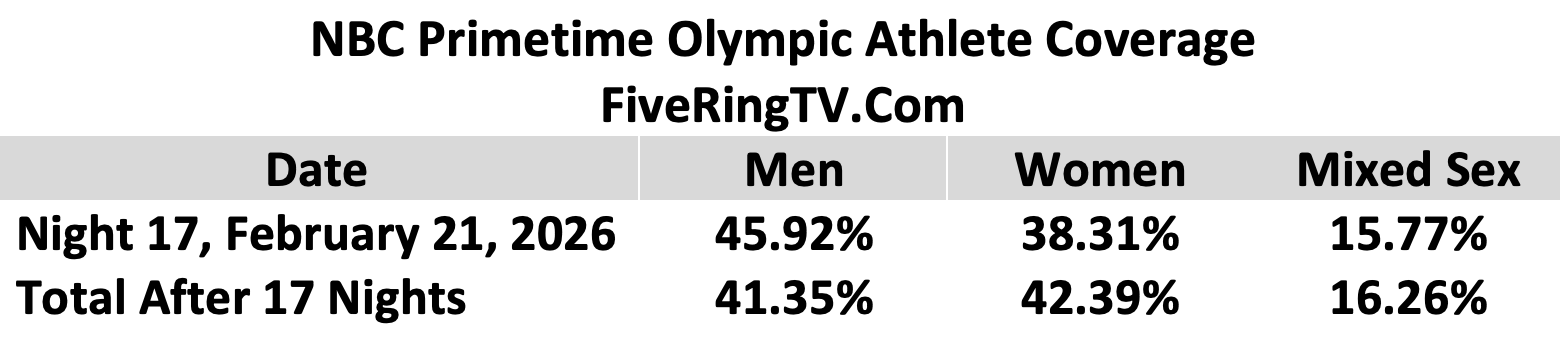
Overall, coverage of men’s events accounted for 45.92% of NBC’s primetime Olympic broadcast. Women’s events received 38.31% of the coverage. Mixed sex events (e.g., ice dancing) received 15.77% of NBC’s coverage.
Buy Olympic Television at Amazon.com
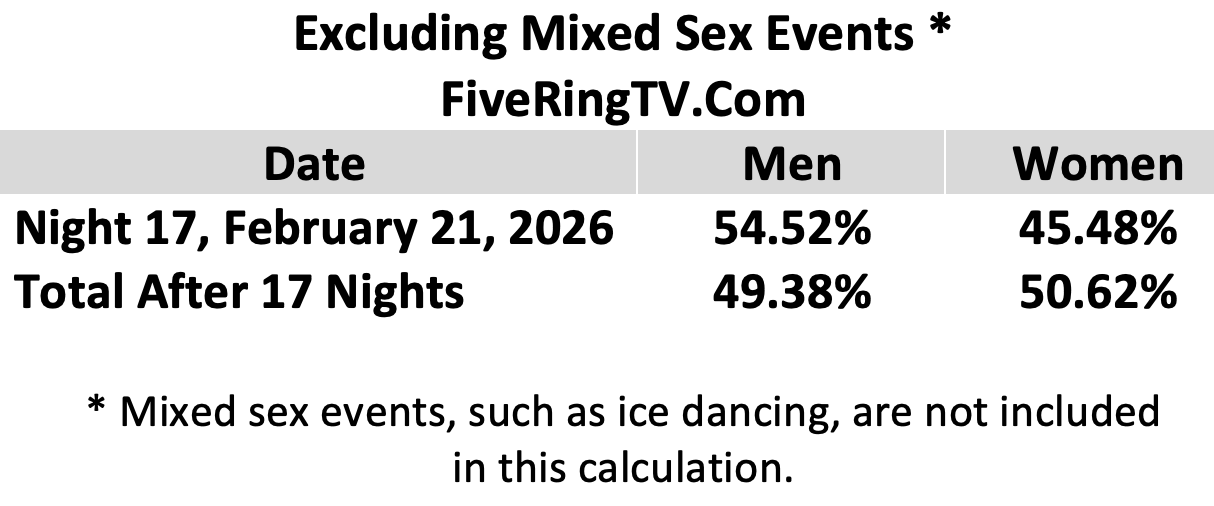
When mixed sex events are excluded, men’s sports received 54.52% of NBC’s coverage compared to 45.48% for women’s sports.
Buy Olympic Television at Amazon.com
Regular updates about NBC’s primetime coverage of men’s and women’s sports will be posted throughout the 2026 Milano Cortina Winter Games on FiveRingTV.com. Updates are also be posted on the @FiveRingTV X feed and the @FiveRingTV Bluesky feed. A final Olympic report, with complete sport-by-sport coverage breakdowns, will also be issued.
—– —– —–
Method: The percentage of primetime devoted to men’s, women’s and mixed sex sports is calculated by a single researcher, utilizing a stopwatch and DVR or DVD time codes, measuring (to the millisecond) the total amount of time devoted to each event. Any time spent at the actual athletic site, on a profile about an athlete, promos about a specific athlete or sport, and host commentary about a specific sport or athlete is recorded. Split screens combining commercials and live coverage are included in the calculations, but commercial breaks are not included. The NBC broadcast network East Coast feed is used for the calculations. Olympic coverage on cable networks and live streaming are not included. Network overruns beyond 11:00pm up to the break for local news are included within the calculations.
—– —– —–
Olympic Television: Broadcasting the Biggest Show on Earth contains a detailed 20-year examination of how male and female athletes have been covered within primetime Olympic broadcasts. The book also has analyses of how race/ethnicity and nationality impact Olympic coverage, interviews with NBC personnel about the content and production of Olympic broadcasts, and a detailed overview of Olympic television history. Published by Routledge, it is available in hardcover, paperback and ebook formats at Amazon.com, the Routledge website, and other outlets.
 Olympic Television