Women’s sports received more airtime than men’s sports during NBC’s primetime Olympic broadcast on Thursday, February 19, 2026 and assumed the overall lead after 15 nights.
After the first 10 nights, men’s sports had received 2 hours, 33 minutes and 53 seconds more NBC primetime broadcast coverage than women’s sports. Men’s sports had received 49.4% of the sports coverage while women’s sports received 33.5% of the coverage; the remainder featured mixed-sex events (17.1%). When mixed sex events are excluded, men’s sports had received 59.53% of the coverage, compared to 40.47% for women’s sports. Men’s sports received more airtime than women’s sports in 6 of the first 10 nights.
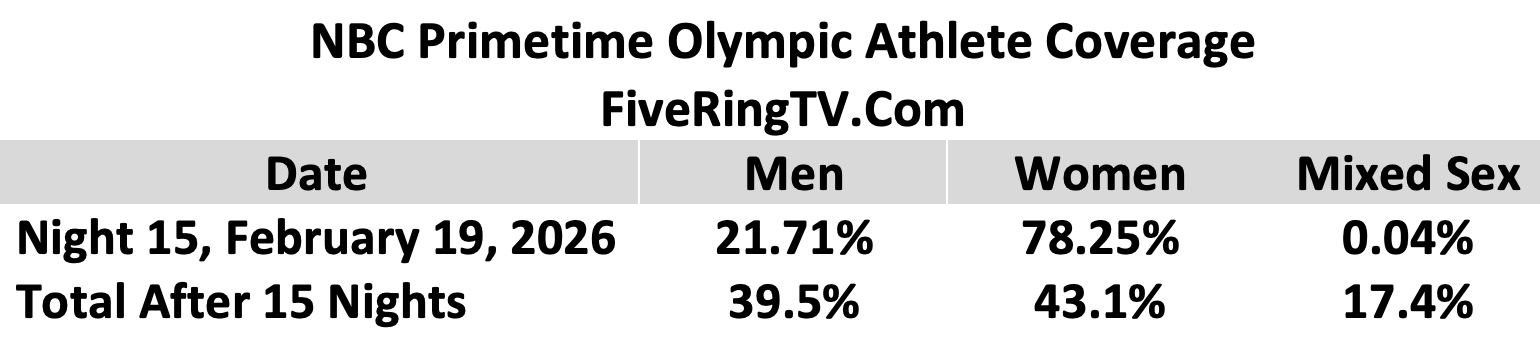
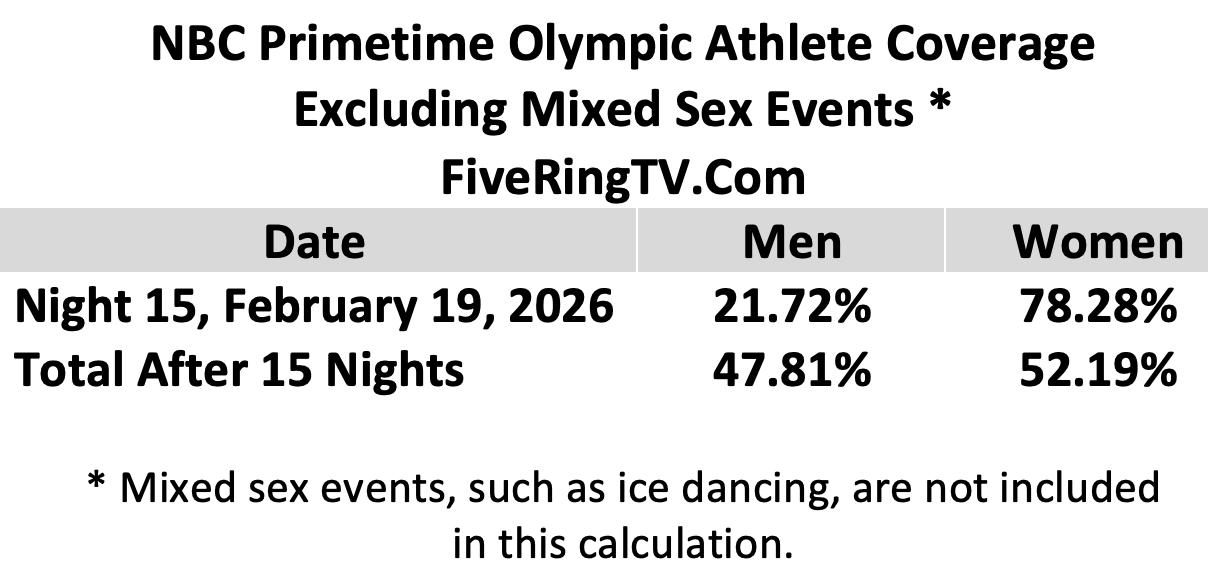
After 15 nights, that gap has not only been erased, but women’s sports have now received 1 hour, 1 minute and 43 seconds more coverage than men’s sports during the first 15 nights of NBC’s primetime broadcast coverage of the Milan Cortina Winter Olympic Games. Women’s sports received 43.1% of the sports coverage while men’s sports received 39.5% of the coverage; the remainder featured mixed-sex events (17.4%). When mixed sex events are excluded, women’s sports have received 52.19% of the coverage, compared to 47.81% for men’s sports. Women’s sports received more airtime than women’s sports in 9 of the first 15 nights.
This pattern is similar to the PyeongChang Games, where men’s sports lead women’s sports at the 10 day mark by almost an identical margin, but by PyeongChang Night 13 women’s sports led the overall coverage and after PyeongChang Night 15 women’s sports held a sizeable advantage. Women’s sports clocked more airtime than men’s sports by the end of the PyeongChang Games, the first time women’s sports had received airtime than men’s sports during a Winter Olympiad since the studies began in 1994.
The 2022 Beijing Winter Games marked the largest coverage gap favoring women’s sports detected on an American primetime Olympic broadcast dating back to 1994 when the studies began. Unlike Milan Cortina and PyeongChang, women’s sports led men’s sports at the 10-day mark in Beijing.
The breakdown of coverage for NBC’s Night primetime broadcast of the Milan Cortina Games follows:
One men’s event had more than one minute of coverage as Speed Skating had more than 27 and a half minutes covering the 1500 meter event for Team USA’s Jordan Stolz winning the silver medal and his third medal overall at the Games. China’s Ning Zhongyan won gold and Kjeld Nuis from the Netherlands won bronze.
Three women’s event received more than one minute of airtime.
Women’s Figure Skating had just under 1 hour and 36 minutes covering the free skate, including a profile of the American and Japanese competitors, another profile specifically about Alysa Liu, and an interview with Alysa Liu as well. Team USA’s Alysa Liu won gold, while Japan’s Kaori Sakamoto and Ami Nakai won silver and bronze respectively.
Women’s Ice Hockey had more than 6 and a half minutes of highlights for Team USA’s victory over Canada in the gold medal game.
Women’s Ski Mountaineering had just over 1 minute with coverage of the first gold medal final ever in the sport, where Switzerland’s Marianne Fatton won gold, France’s Emily Harrop won silver, and Spain’s Ana Alonso won bronze.
No mixed events had more than one minute of coverage.
Overall, coverage of men’s events accounted for 21.71% of NBC’s primetime Olympic broadcast. Women’s events received 78.25% of the coverage. Mixed sex events (e.g., ice dancing) received 0.04% of NBC’s coverage.
Buy Olympic Television at Amazon.com
When mixed sex events are excluded, men’s sports received 21.72% of NBC’s coverage compared to 78.28% for women’s sports.
Buy Olympic Television at Amazon.com
Regular updates about NBC’s primetime coverage of men’s and women’s sports will be posted throughout the 2026 Milano Cortina Winter Games on FiveRingTV.com. Updates are also be posted on the @FiveRingTV X feed and the @FiveRingTV Bluesky feed. A final Olympic report, with complete sport-by-sport coverage breakdowns, will also be issued.
—– —– —–
Method: The percentage of primetime devoted to men’s, women’s and mixed sex sports is calculated by a single researcher, utilizing a stopwatch and DVR or DVD time codes, measuring (to the millisecond) the total amount of time devoted to each event. Any time spent at the actual athletic site, on a profile about an athlete, promos about a specific athlete or sport, and host commentary about a specific sport or athlete is recorded. Split screens combining commercials and live coverage are included in the calculations, but commercial breaks are not included. The NBC broadcast network East Coast feed is used for the calculations. Olympic coverage on cable networks and live streaming are not included. Network overruns beyond 11:00pm up to the break for local news are included within the calculations.
—– —– —–
Olympic Television: Broadcasting the Biggest Show on Earth contains a detailed 20-year examination of how male and female athletes have been covered within primetime Olympic broadcasts. The book also has analyses of how race/ethnicity and nationality impact Olympic coverage, interviews with NBC personnel about the content and production of Olympic broadcasts, and a detailed overview of Olympic television history. Published by Routledge, it is available in hardcover, paperback and ebook formats at Amazon.com, the Routledge website, and other outlets.
 Olympic Television