Men’s sports received more coverage than women’s sports during NBC’s primetime Paris Olympic broadcast on Saturday, July 27, 2024.
Men’s time totals were driven by the qualifying round for men’s gymnastics (more than 41 minutes) and men’s swimming (more than 26 minutes). Swimming included the 400m freestyle final and Team USA winning the 4×100 freestyle relay. There was also just under two minutes of coverage of the men’s rugby gold medal match where France defeated Fiji.
On the women’s side, the most airtime was devoted to swimming (more than 26 minutes) which included the 400m freestyle (where Team USA’s Katie Ledecky won bronze) and the 4×100 meter freestyle relay (where the U.S. took silver behind Australia’s gold). Diving clocked in nearly 17 minutes, as Kassidy Cook and Sarah Bacon won silver in the synchronized springboard, the first medal for Team USA in Paris and the first medal for the U.S. in this event since 2012. Lastly, there was just over a minute of gymnastics due to discussion of Simone Biles starting her competition on Sunday..
No mixed sex events were covered.
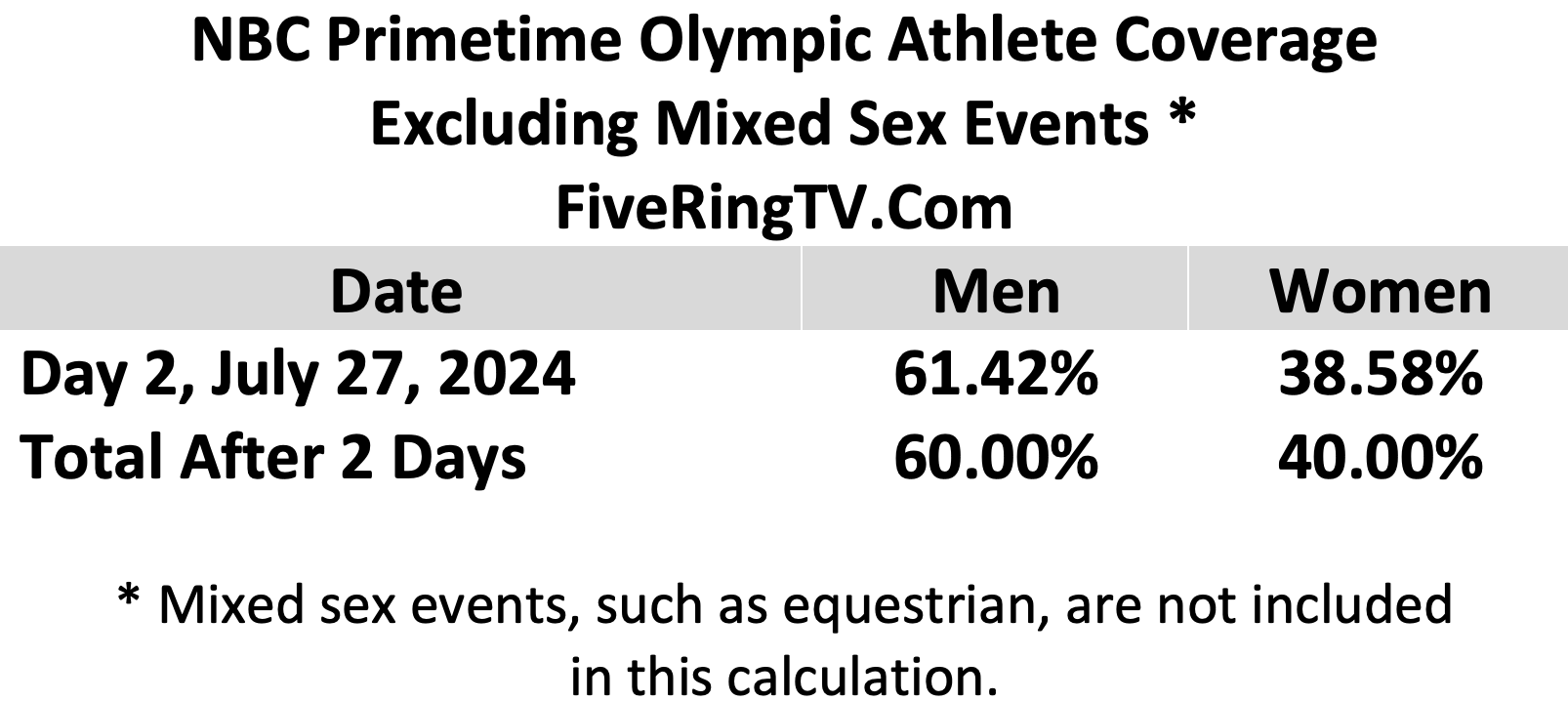
Overall, coverage of men’s events accounted for 61.42% of NBC’s primetime Olympic broadcast. Women’s events received 38.58% of NBC’s coverage. Mixed sex events (e.g., equestrian) received 0.00% of NBC’s coverage.

Buy Olympic Television at Amazon.com
After 2 nights, when mixed sex events are excluded, men’s events have received 60.00% of NBC’s primetime broadcast coverage compared to 40.00% for women’s events.
Buy Olympic Television at Amazon.com
Regular updates about NBC’s coverage of men’s and women’s sports will be posted throughout the 2024 Paris Summer Games on FiveRingTV.com. Additional updates will also be posted on the @FiveRingTV X feed. A mid-Olympic report, with complete sport-by-sport coverage breakdowns, will also be issued.
—– —– —–
Method: The percentage of primetime devoted to men’s, women’s and mixed sex sports is calculated by a single researcher, utilizing a stopwatch and DVR or DVD time codes, measuring (to the millisecond) the total amount of time devoted to each event. Any time spent at the actual athletic site, on a profile about an athlete, promos about a specific athlete or sport, and host commentary about a specific sport or athlete is recorded. Split screens combining commercials and live coverage are included in the calculations, but commercial breaks are not included. The NBC broadcast network East Coast feed is used for the calculations. Olympic coverage on cable networks and live streaming are not included. Network overruns beyond 11:00pm up to the break for local news are included within the calculations.
—– —– —–
Olympic Television: Broadcasting the Biggest Show on Earth contains a detailed 20-year examination of how male and female athletes have been covered within primetime Olympic broadcasts. The book also has analyses of how race/ethnicity and nationality impact Olympic coverage, interviews with NBC personnel about the content and production of Olympic broadcasts, and a detailed overview of Olympic television history. Published by Routledge, it is available in hardcover, paperback and ebook formats at Amazon.com, the Routledge website, and other outlets.
 Olympic Television